Alabama’s Ronnie Baynes went from high school coach to NFL officiating legend

No Alabama sports official can boast a better resume than Ronnie Baynes.
Baynes, who started out in the Alabama High School Athletic Association as a high school coach, spent 26 years as a football official in the Southeastern Conference and the NFL – mostly as a line judge – and worked two Super Bowls. He later rose to supervisor of NFL officials and was awarded the NFL’s Art McNally Award in 2011 for exemplifying professionalism, leadership and commitment to the art of officiating.
Baynes juggled his high school baseball and football coaching duties at Tallassee and officiating in the SEC and the NFL.
“I would finish a high school game and usually drive all night or drive to Atlanta and sleep and get on an early-morning flight or something,” he said. “I did that until it became too much, and I got out of football coaching and kept coaching baseball at Tallassee.”
Baynes built Tallassee baseball into a championship dynasty, winning state titles in 1986, 1987, 1989, 1990 and 1991. Throw in a runner-up finish in 1985 and his Tallassee teams advanced to the championship round six times in a seven-year run.
Baynes also spent 13 seasons as a head football coach at A.G. Parrish High School in Selma and at Tallassee after playing football and baseball at Auburn University in the 1960s. In college he was a Second Team All-SEC defensive end. His career also included stops at the Alabama School for the Deaf as an administrator and a seven-year stint as baseball coach at Mountain Brook High School.
Baynes was inducted into the AHSAA Hall of Fame in 2002 and the Alabama Sports Hall of Fame in 2013. Now in his 80s and in semi-retirement, he still works behind the scenes to help officials in the SEC and the United Football League.
Baynes was involved in two major officiating training events in Montgomery recently: the AHSAA’s Officiate Alabama Day and the National Association of Sports Officials (NASO) Summit. He was excited about spending time with Mike Pereira, who spoke at the Alabama events.
In a recent phone interview, Baynes discussed his officiating career.
Q: Are there similarities between officiating and coaching, and, if so, what were they?
Baynes: I think as long as you’re talking about sports – whether you’re playing, whether you’re coaching, whether you’re officiating – there’s certain standards and things you get involved with. It’s mainly hard work and commitment and dedication to something. They’re all similar. I think they all help each other. I don’t think one is stronger than another. I think officiating helped me as coach. I think coaching helped me be better as an official.
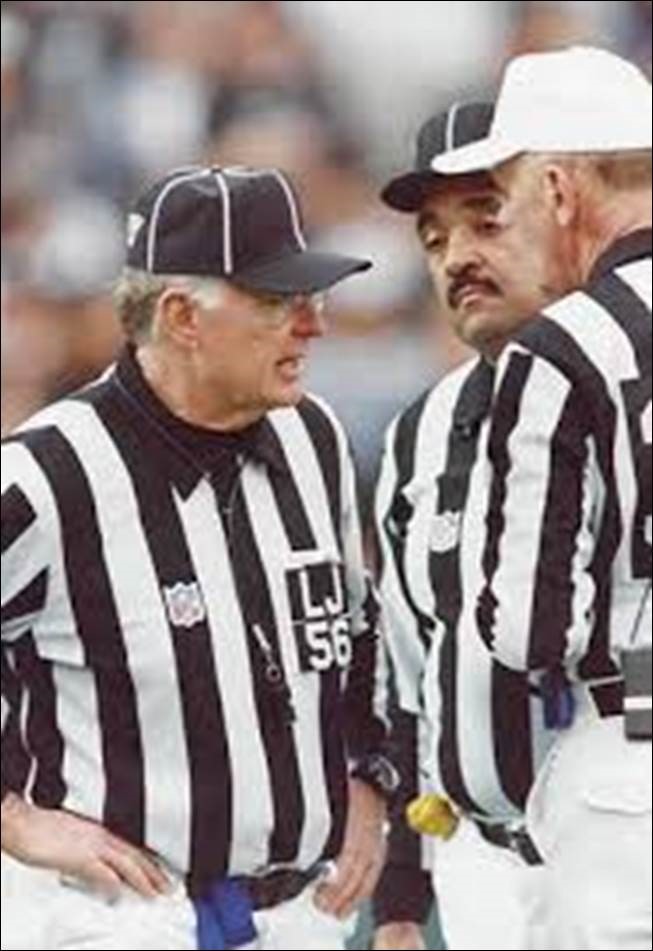
Longtime NFL official Ronnie Baynes, left, works a game. (contributed)
Q: What advice do you give young or new officials?
Baynes: When I talk to a new person about it, I will say their background in sports is good. I recently talked to a young man who had been a college coach and played in college in Mississippi, and he showed some interest. I told him, ‘The thing to do is give it a try. I didn’t think I was going to like football officiating, but once I did it and I liked it.” Learn. Use your sporting background. Go give it a try and it’s not for everybody.
For instance, my son-in-law tried it. He called me after his first game and said, “Oh, this is great.” I called him after his second game, and he said he’d never do it again. Why not? He said, “I made a bad call, and the fans booed me and screamed at me, and it was terrible.” I said, ‘That’s just part of the learning process.”
He then said a great statement that I use on new officials. He said, “I like people to like me too much to be an official.” OK, I understand that. You’re not going to get liked all the time when you officiate. I share that story with new people and basically tell them to give it a shot. Then, work hard at it just like you do when you played the game or coached it or whatever.
Q: What advice do you have for officials when it comes to handling criticism, especially in today’s era with the social media landscape, which perhaps you didn’t have to deal with as an active official?
Baynes: Officiating, especially at the high school level, is having a difficult time getting people to officiate, just because of the criticism from social media. You now see a lot of Thursday night games because there’s not enough officials to cover everybody on Friday night. One thing for sure, we asked the officials at higher levels to stay off social media. Don’t even look at that stuff and for sure don’t comment about it. Don’t try to get involved in all that stuff. Just stay focused on the game.
You’re going to make mistakes, and the way you handle mistakes is learn from them and correct yourself and move on. Take the criticism that Ronnie Baynes is going to give you when he evaluates you. Take the criticism from your (local) supervisor. Take your coach complaints. It’s going to happen and be part of it. You have to move on and learn from it and don’t make that mistake again, if you can.
Q: When you look back on your career and when you first started in officiating, is there advice you wish someone would have told you that might have helped?
Baynes: I don’t know if you remember the cereal Rice Krispies that had the slogan, “Snap, crackle and pop.” For the line of scrimmage, I was told snap first, tackle second and pop third. What goes on there? It’s “Snap, tackle and pop,” but after all these years, the best thing for a line-of-scrimmage official is to first look at the ball and make sure it’s a legal snap and make sure all the line of scrimmage guys are legal before the snap.
Once you’ve got a legal snap off, you look at the tackle. If he goes into a pass block, you go into your pass mechanics. If he shows you a run block, you go into your run mechanics. Then, once that happens, you look for the contact – you’re looking for the pop. That’s one thing I’ve taught through the years.
Q: Do you have a favorite story from your time in the NFL?
Baynes: I could write a book about that. I’ve got about 10, but here is a short one for you. I kept a record of the coaches who were toughest to work. One of the toughest ones – and I really liked it him – was Chuck Knox. He was coaching in Seattle, Washington. He was tough on the sideline. He was tough on officials.
The first time I worked a game in Seattle and being on the line of scrimmage and being a line judge, he was jumping all over me and I heard from other officials that this is what he did all the time. He said, “You guys are awful. You guys are terrible. All y’all do is sell life insurance and don’t know anything about football. Y’all are just the worst.” Blah, blah, blah.
It caught me off guard and I never said anything about it. I went back and did the second game, and he started with the same old speech. He said, “You guys are terrible. All you guys do is sell life insurance. You don’t know anything about football or have any connection to football.” He got up in my ear and he said, “What do you do?”
I had been waiting for that. I jumped around and looked at him and said, “I coach,” and it took him back for a minute. He was in shock. He kind of calmed down and came back and said, “Where do you coach?”
I didn’t want to say I coached in Tallassee, Alabama, because I knew he wouldn’t know where that was. So, I said, “Montgomery, Alabama.” He said, “Well, I understand that. You probably coach at Sidney Lanier High School.” That took me back. I was in shock.
So, here I was in Seattle, Washington, and an NFL coach there knew about Sidney Lanier High School. I couldn’t believe it. How about that?
This story originally was written for the Alabama High School Athletic Association.