James Spann: Showers in Alabama remain isolated; mostly dry weekend ahead

RADAR CHECK: A few isolated showers and storms have formed this afternoon over parts of central and south Alabama; heavier thunderstorms are over the southern half of the state, moving westward. The rest of the state is dry with temperatures in the upper 80s and low 90s. Showers and storms will end quickly after sunset.
CALM SUMMER PATTERN: A quiet weather pattern continues across the Deep South through the holiday weekend, with partly sunny days, fair nights and only isolated afternoon showers. The chance of any one community seeing a shower each afternoon is 10-20%, and afternoon highs will be between 90 and 95 degrees.
The weather won’t change much for at least the first half of next week. Afternoon showers will remain widely spaced, and highs will hold in the low to mid 90s. There could be a slow increase in the number of scattered afternoon showers and storms toward the end of the week, but there’s still no sign of any really widespread rain setup.

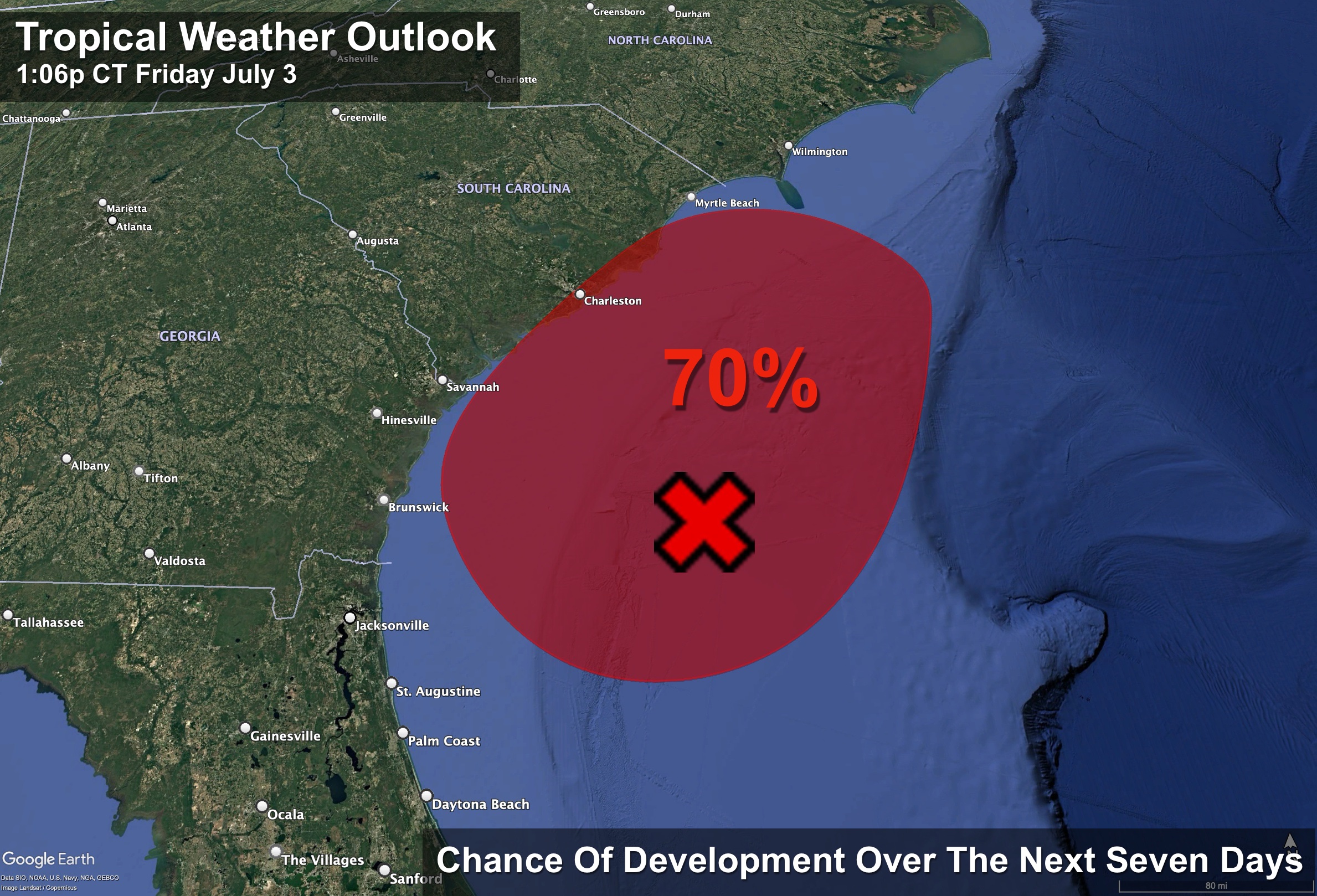
TROPICS: Satellite wind data indicates the system in the Atlantic about 150 miles off the northeast Florida coast has become better defined today with an area of strong winds on its east side. Showers and thunderstorms are also persisting near and east of the center.
A short-lived subtropical or tropical depression could form later today or Saturday while the system drifts generally north-northwestward. This low is expected to move inland over the southeastern United States by early Sunday. An Air Force Reserve Hurricane Hunter aircraft is en route, and the data it collects should provide more details on the system’s structure. Regardless of development, heavy rainfall is possible across portions of west-central and southwestern Florida through early Saturday and across coastal sections of the Carolinas later Saturday.
The National Hurricane Center gives the system a 70% chance of development; the rest of the Atlantic basin (including the Gulf) is very quiet.
ON THIS DATE IN 1911: Record temperatures were set in the northeastern United States as a deadly heat wave hit the area that would go on to kill 380 people. In Nashua, New Hampshire, the mercury peaked at 106 degrees. Other high-temperature records were set all over New England during an 11-day period.
For more weather news and information from James Spann and his team, visit AlabamaWx.