Economic Development Partnership of Alabama giving tech boost to targeted industries

The Alabama Business Intelligence Center (AL Intel) at the Economic Development Partnership of Alabama (EDPA) is working to give a proactive tech boost to traditional and targeted industries in the state.
Since Catalyst, the state’s new economic development strategic plan, was adopted almost a year ago, EDPA has looked at ways it can work with the Alabama Department of Commerce, Innovate Alabama and local economic developers to best implement that plan.
Catalyst identified eight strategic sectors the state should be targeting in its recruitment and expansion efforts: mobility (automotive and aerospace), defense, metal and advanced materials, chemical manufacturing, forestry and wood, agriculture and food, technology, and bioscience. Four of those were ripe for the alignment of growth-stage startups: mobility technology, defense technology, forestry technology and biotechnology. AL Intel has been exploring those opportunities.
“This year, there were four key sectors that were identified out of Catalyst to focus efforts proactively on how the state can put its best foot forward,” said Miller Girvin, who became president of EDPA early this year and gave an update on the organization at the Economic Development Association of Alabama’s summer conference. “AL Intel, the Business Intelligence Center at EDPA, has done a fantastic job of diving really deeply into those sectors and providing both data and insight that our local developers can act on when they are trying to recruit new businesses or retain or expand the ones that are already in their communities.”
It’s an effort that combines two of EDPA’s five functional pillars: lead generation and business intelligence (the others are innovation and entrepreneurship, talent and policy).
For instance, AL Intel could identify a growth stage company in one of those sectors, generate a lead for recruitment, work with Commerce or Innovate Alabama or another appropriate partner and then support the project management process to hopefully an announcement.
Those tech companies can then work with other companies in the targeted industry to aid in their growth.
“I think we all know if you’re not innovating as a company, you’re often dying,” Girvin said. “Being able to add some really innovative companies in Alabama to supplement and help grow those existing industries in places where Alabama really has a value proposition is a cool opportunity that we’re leaning into. We’re excited to see that really start to move the needle.”
Another program EDPA oversees that has been moving the needle is SEEDS, or Site Evaluation and Economic Development Strategy. The program provides grants that are combined with local matching funds to help identify, acquire and develop industrial sites. EDPA, which keeps a database of available sites around the state and helps certify the best prepared properties in its AdvantageSite program, also oversees the SEEDS program.
“SEEDS is incredible. It has given us the funding and the structure to continue to develop new industrial sites across the state of Alabama,” Girvin said. “We needed more sites in the database. We needed more product to be able to market as a state, and SEEDS has accomplished that and continues to accomplish that. We currently have 23 sites that have been submitted to 20 different active projects.”
There have been two rounds of SEEDS grants and a third round is taking applications through Sept. 30.
In the first two rounds, SEEDS had 42 site assessment applications and 32 grants were distributed for $2.53 million; 34 development applications and 24 grants for $50.98 million were distributed.
That has led to 25 sites that have been submitted for active projects and three of those are looking like they are close to an announcement, Girvin said.
“I’m thrilled to see the momentum that that program has created for our industrial sites.”
RELATED: Restructured Alabama Department of Commerce pursuing more than 100 projects
On the policy side, EDPA was among those advocating for economic development incentives like the Powering Growth Act and the creation of the Alabama Development Fund in this year’s legislative session.
Powering Growth helps streamline permitting, correct supply chain issues and fund energy development at industrial site. It also creates the Alabama Infrastructure Bank, which provides flexible financing for power infrastructure tied to industrial growth and jobs, funds energy infrastructure expansion to sites around the state and helps strengthen the grid.
“Energy infrastructure is critical to the ability to win a lot of these projects, so we’re excited to see that Infrastructure Bank get off the ground and start to make waves for Alabama competitively.”
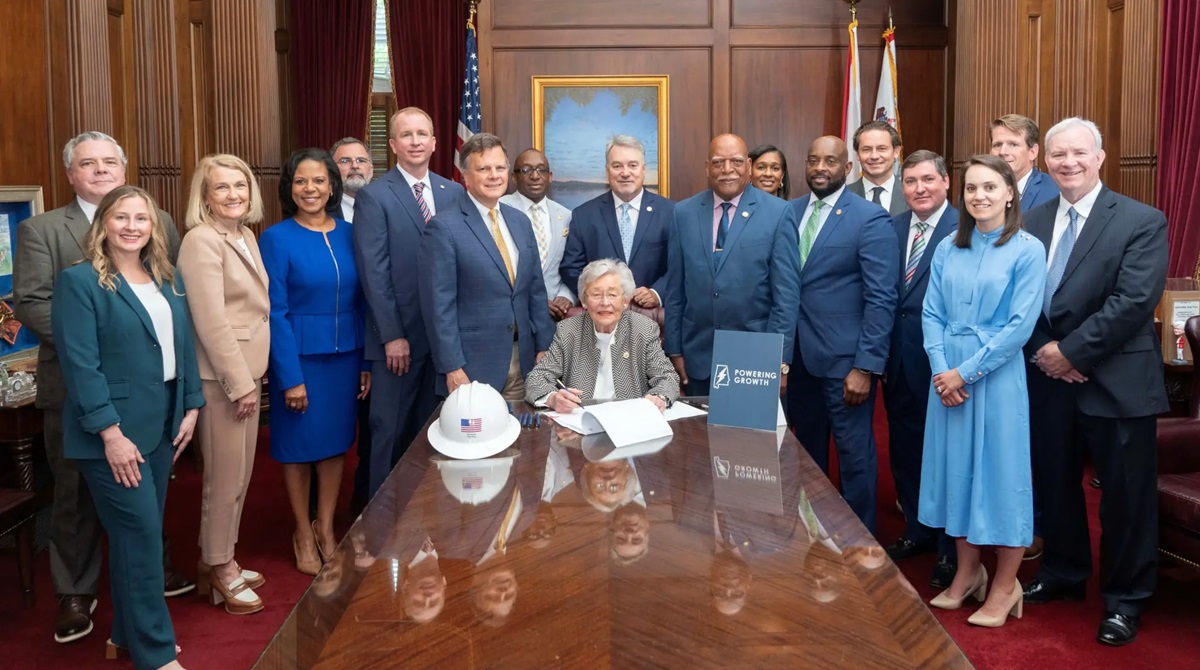
Alabama Gov. Kay is joined by supporters of the Powering Growth legislation, which she signed into law on Wednesday. The legislation addresses potential critical energy infrastructure supply chain vulnerabilities across Alabama. (contributed)
When it becomes effective on June 1, 2026, the Alabama Development Fund initiative will generate new funding for economic development by retaining a small portion of sales and property taxes that are abated in qualified economic development projects after that date.
“The Alabama Development Fund is a gamechanger,” Girvin said. “(Commerce) Secretary (Ellen) McNair really led the charge on getting that across the finish line. I think it’s going to be a really positive asset and provide great resources for economic development in the state of Alabama.”
Earlier this year, EDPA announced its acquisition of Birmingham Bound, a pioneering initiative that has successfully attracted more than 20 technology companies to the Magic City since its founding in 2018 by Shipt to support Birmingham’s growing innovation ecosystem.
Girvin said the plan is to take it statewide.