Alabama’s Redstone Arsenal hosts evaluation on Army’s Future Long-Range Assault Aircraft

The U.S. Army’s Future Long-Range Assault Aircraft (FLRAA) program reached a major milestone with its third Special User Evaluation (SUE) at Redstone Arsenal.
The evaluation gave real-world operational context for the aircraft’s design, bridging the gap between engineering and battlefield application. Army aviators executed the event in a simulated operational environment, giving developers insights into how soldiers plan and execute tactical missions using cutting-edge technology. Pilots from the Aviation Capability Development and Integration Directorate, Directorate of Training and Doctrine, Fort Novosel’s Directorate of Evaluations and Standardization, Systems Integration Management Office, Future Vertical Lift Cross Functional Team and Redstone Test Center represented all three enduring fleet platforms.
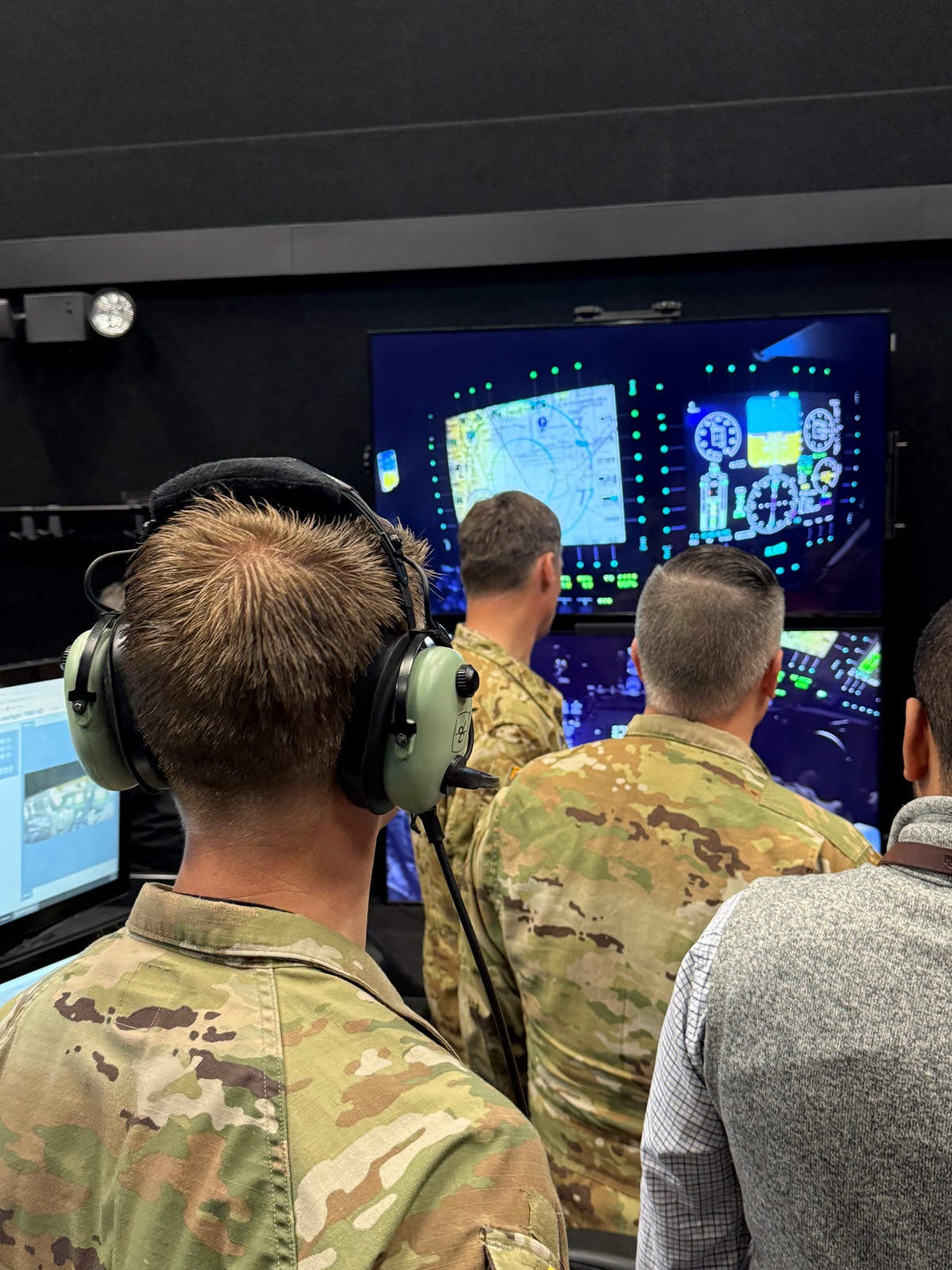
Army aviators collaborate with the Future Long-Range Assault Aircraft (FLRAA) team and industry partners during a simulated test run in the Black Hawk Air Crew Trainer. The exercise provided crucial feedback to refine the FLRAA’s design for real-world combat scenarios. (Morgan Pattillo)
“We’re going to see how you plan missions today, and we want to see how you want to plan missions in the future,” Col. Jeffrey Poquette, FLRAA program manager, told soldiers and industry members. “What we’re going to deliver with our partners will be a truly transformational aircraft. I hope some of you in the future get the chance to fly the MV-75 FLRAA.”
The SUE’s core objective was to observe and analyze how aviators strategize in a realistic mission setting, including mission planning, execution and contingency responses. Engineers from Bell Textron Inc. and Lockheed Martin observed how pilots adapt to unexpected challenges within the simulation, identifying potential areas for improving the aircraft’s design and functionality.
“The SUE was a great event enabling industry partners to hear from the ultimate customer, the soldier,” said Chief Warrant Officer 4 Josh McCoy, from the Redstone Test Center. “Bell had the opportunity to learn how the soldiers receive, plan, rehearse and execute an air assault mission, to include contingencies throughout the mission.”
Beyond flight operations, the SUE event also delved into the critical cybersecurity domain. Discussions with operational users focused on understanding the FLRAA’s cybersecurity features and how they integrate into real-world mission scenarios. This collaborative approach ensures the aircraft can withstand evolving cyber threats and maintain secure communication and data integrity in contested environments.
“The SUE was an extremely unique opportunity to participate in, benefiting all parties. The ability to interface directly with the engineers from Bell and Lockheed made a direct, positive impact on the FLRAA program. Their participation and feedback in the event reminded aviators that they are vested in the program and want to deliver the best and most capable product they can,” a pilot from the 160th Special Operations Aviation Regiment remarked. “SUE events like this should be more frequent, and I feel they would help streamline and drive the development process.”
The SUE event marks a significant step forward for the FLRAA program. By prioritizing soldier input and experience, the program continues to refine the aircraft’s design, ensuring it delivers the transformational, advanced capabilities needed for future battlefield dominance.