As Alabama's fiber network grows, Alabama Power trains crews to keep customers connected

Broadband fiber has connected more Alabama communities than ever before while making the electric grid smarter and more reliable. To make sure those benefits continue to customers after storms, Alabama Power is training crews across the state to restore the company’s rapidly expanding fiber network alongside electric service.
While about 20% of Alabama Power’s fiber is buried underground, 80% of fiber-optic cable is aerial, mounted alongside power lines on utility poles.
When storms topple trees, bring down poles or damage power lines, fiber lines often come down with them.
Restoring fiber isn’t as simple as restringing electric lines (which itself is no easy task).
Power lines are built to withstand more tension. Fiber cables require a gentler touch. And because minimizing service disruption for customers is Alabama Power’s priority, the company’s crews participate in specialized training to restore both systems safely and efficiently.
Alabama Power has made that training a priority. About 90% of company Distribution crews have been trained to replace fiber, with refresher courses regularly offered in areas where fiber infrastructure is especially dense.
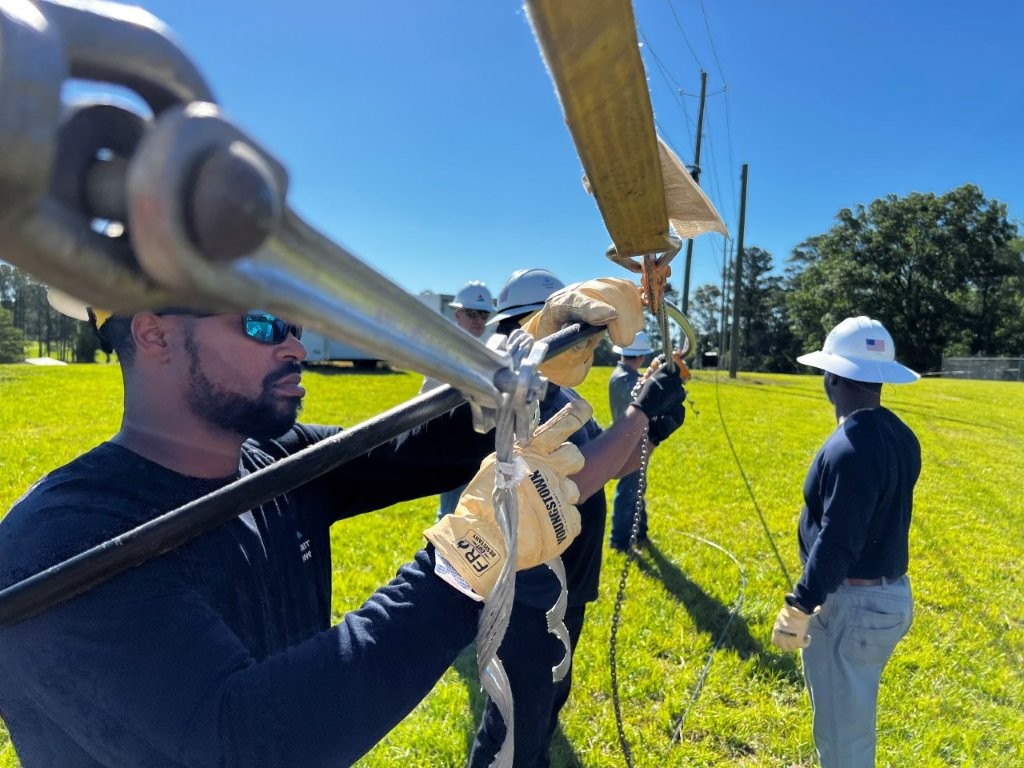
An Alabama Power line crew is trained to install fiber-optic cable lines on power poles. (Michael Tomberlin / Alabama News Center)
“The more fiber we get put out there, the more teams we need to do basic maintenance on the fiber, be able to perform transfers in areas where the FTD (fiber to distribution) is located, so we don’t have unnecessary dispatches out with multiple crews to do the same thing,” said James Ehlers, Power Delivery Technical Training instructor at Alabama Power.
Crews learn to replace the damaged fiber using appropriate methods. They also learn where and how to mount hardware on the poles and how much slack, extra line and other special equipment to incorporate into the work.


Training crews to restore both power and fiber during the same response improves efficiency and allows them to fully connect customers faster.
“When the crews are out there, they’re able to put the power back up, and at the same time, while they’re out there, go ahead and put the fiber back up into its spot,” Ehlers said. “This is just one more way to increase reliability on our network.”
Connectivity crew
Attaching fiber cable to poles is difficult enough. Connecting or repairing a damaged fiber-optic line presents its own challenges.
At the Alabama Energy Infrastructure Training Center and Network (AEITCN) at Bevill State Community College in Jasper, lineworkers are given a chance to get specialized training, such as splicing and testing of fiber, fiber-optic network design, fiber characteristics, optical LANs and fiber for wireless. They learn premises cabling (fiber, copper and wireless) installation, outside plant installation and data center cabling.
Jason Quick is the foreman of an Alabama Power crew that includes two lead linemen and six linemen. His team recently completed the 40 hours of training and two-hour exam.


“This allowed us to be FOA (Fiber Optic Association) certified as a fiber-optic technician to work in all aspects of fiber optics including construction, installation, testing, operations and maintenance,” Quick said. “I am extremely proud of how the guys have taken the steps to be the best in the business and perfect their skills in this field so we can better maintain our system and deliver a top-quality product for our customers.”
Alabama Power is believed to have the first Connectivity Crew in the country and continues to build on that foundation.
“The workforce we need five years from now is being designed today. That takes more than training – it takes collaboration,” said Stevie Searcy, director of Workforce Development and Training at Alabama Power. “We work with Alabama Power teams, industry partners and educators to anticipate future skill needs, upskill today’s workers and prepare the next generation for careers that will power Alabama’s future.”
Alabama Power has deployed 1,300 miles of distribution grid fiber since 2017, with 836 miles of fiber installed since 2022. Last year a record of 300 miles in a year was reached.


Industry recognition
The Southeastern Electric Exchange (SEE) awarded Alabama Power with its Chairman’s Award this year, the highest distinction at the 2026 SEE Industry Excellence Awards. Alabama Power won the award for the pace at which it designed, permitted and constructed new fiber infrastructure last year.
“The program extended broadband potential to more than 500 Community Anchor Institutions across Alabama, including rural schools, hospitals and municipal facilities,” SEE said in announcing the award. “By integrating with ~5,000 miles of existing fiber, the team achieved coverage in all 67 Alabama counties – more than four months ahead of grant deadlines.”
Southern Company, Alabama Power’s parent company, received the APEX Award from the Utilities Technology Council last month. That award was for its FTD and long-haul network expansion across Alabama.


“Fiber is essential infrastructure. Just as electricity powers our communities, fiber powers the communication systems that keep our grid resilient, our emergency services connected and our future moving forward,” said Fiber Construction, Contracts and Inspector Supervisor Holly Joiner at Alabama Power. “That’s why we’re committed to maintaining it with the same level of care and reliability as our electric lines.”
Alabama Power uses fiber-optic cable for electric grid operations and reliability. Excess capacity is leased to other operators, such as broadband internet providers helping connect communities.
“The electric grid of tomorrow relies on two lifelines: power and information,” Joiner said. “Electricity travels on our lines, and information travels on our fiber. Both are essential, and both deserve the same unwavering commitment to reliability and maintenance.”